BCB Integrations –
Connecting the systems at the heart of clinical work
BCB Integrations is a healthcare integration platform from BCB Medical. It helps healthcare organisations reduce manual work and improve data quality by moving clinical and administrative information securely and automatically between systems. This ensures that relevant patient information is available where it is needed, when it is needed.
The platform connects BCB Medical’s Clinical Information Management Systems (CIMS) with electronic health record (EHR) systems and other healthcare information systems, helping information flow securely between clinical, administrative and reporting environments.
How BCB Integrations work
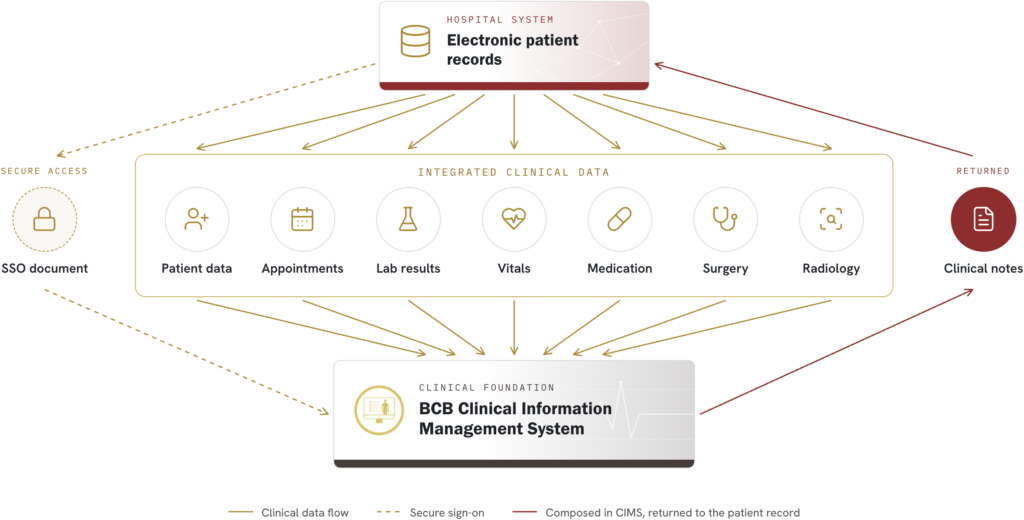
BCB Integrations exchange data automatically in both directions between BCB’s CIMS and the hospital’s own systems. It:
Connects BCB CIMS with other healthcare information systems
Automatically transfers data on operations, laboratory values, medication, examinations and other patient information from the hospital’s EHR
Sends automatically generated surgery reports and patient notes back to the EHR in a standardised, structured format
Eliminates the need for manual double entry
Makes relevant disease-specific clinical data sets available online
75+ hospital system integrations delivered
Benefits for healthcare professionals
BCB Integrations help healthcare professionals access the information they need without switching between multiple systems. Relevant clinical data is automatically transferred and made available where it is needed, supporting more efficient workflows and reducing administrative burden.
By eliminating manual data transfers and duplicate documentation, clinicians can spend less time on data entry and more time on patient care. Standardised data flows also improve data quality and help ensure that patient information is accurate and up to date across systems.
Key benefits for clinicians:
Less time spent on manual documentation and duplicate data entry
Faster access to relevant patient information
Improved data quality and consistency across systems
More efficient clinical workflows
More time available for patient care and decision-making
Benefits for healthcare organisations
Healthcare organisations typically rely on multiple clinical and administrative systems. BCB Integrations connect these systems, enabling secure and reliable data exchange across departments, hospitals, registries, and data repositories.
By automating data flows, organisations can reduce administrative workload, improve operational efficiency, and ensure that clinical data is available for reporting, quality improvement, research, and analytics. Standardised integrations also support consistent data collection and help organisations build a stronger foundation for data-driven healthcare.
Key benefits for healthcare organisations:
Reduced administrative workload and operational costs
Improved data quality and reliability
Automatic information flow between clinical systems
Faster access to data for reporting and quality monitoring
Scalable integration platform compatible with existing and future systems
Supported systems and standards
BCB Integrations support integration standards, e.g. HL7 v2, HL7 FHIR, REST APIs and can integrate with any electronic health record system (EHR). More than 75 integrations with hospital systems have been delivered in Finland, in Sweden and in the UK.
FAQ – BCB Integrations
BCB Integrations exchange data automatically in both directions between BCB’s CIMS and the hospital’s own systems, so clinicians no longer enter the same data twice. It also makes relevant disease-specific clinical data sets available online.
How do BCB Integrations work?
It supports HL7 v2 and HL7 FHIR and can integrate with any electronic health record (EHR) system.
Which integration standards does it support?
More than 75 integrations with hospital systems have been delivered in Finland, Sweden and the UK.
How many hospital integrations has BCB delivered?
The engine pulls data on operations, laboratory values, medication, examinations and other patient information from the hospital’s EHR. It sends automatically generated surgery reports and patient notes back to the EHR in a standardised, structured format.
What data flows between the EHR and BCB CIMS?
Yes. Automatic transfers eliminate manual double entry and duplicate documentation, which frees clinician time and improves data quality and consistency across systems.
Do integrations remove manual double entry?
Integrations connect the organisation’s clinical and administrative systems and enables secure data exchange across departments, hospitals, registries and data repositories. That reduces administrative workload and operating costs and makes data available faster for reporting, quality monitoring, research and analytics. The platform is scalable and compatible with existing and future systems.
How do integrations help a healthcare organisation?
Get started
See your data come to life
A 30-minute walkthrough of registries, analytics and quality monitoring with your own specialty in mind.