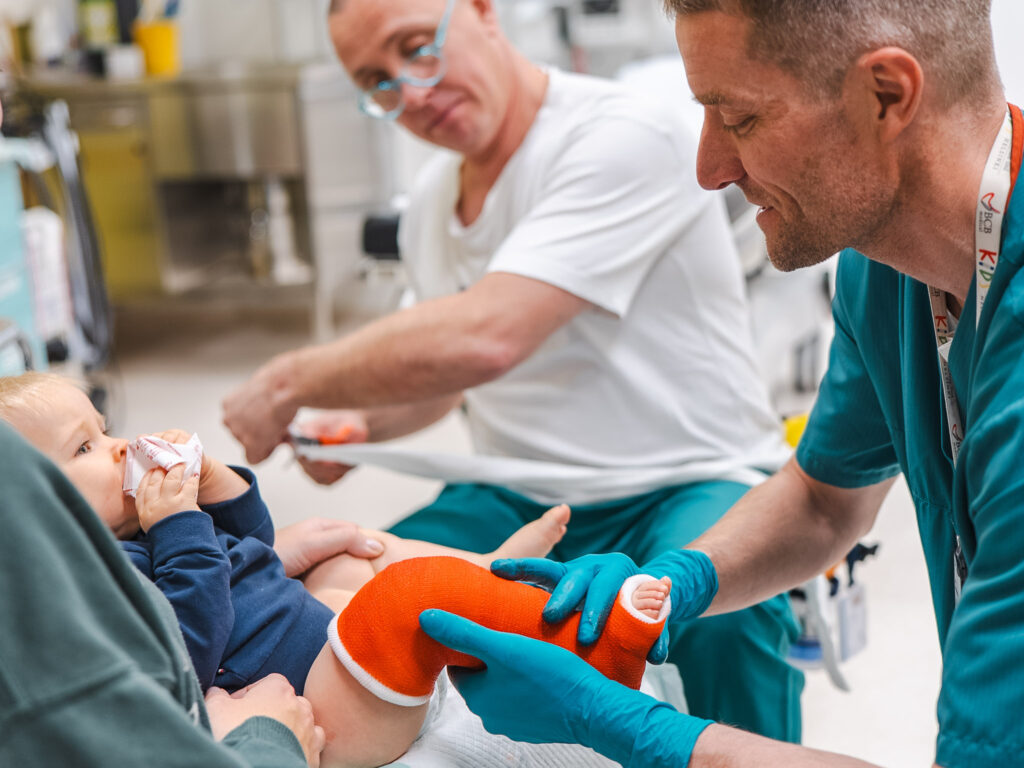
Children’s fractures are among the most common injuries requiring treatment within the Hospital District of Helsinki and Uusimaa (HUS). To serve this patient group and the professionals working with them, the KIDS Fracture Tool has been developed. It brings together fracture data, treatment guidelines, and quality monitoring into one system. At the New Children’s Hospital, the KIDS Fracture Tool has transformed everyday work in the emergency department, on the wards, and even in the operating theatre – and most importantly, it has improved patient care. The tool has been developed in collaboration with BCB Medical to function seamlessly as part of the hospital’s overall information systems.
KIDS Fracture Tool Supports Decision-Making and Consistency in Care
The KIDS Fracture Tool is one part ot the hospital’s electronic health record systems and a quality registry that provides information to support the treatment of children’s fractures throughout the care pathway. It plays a particularly important role in the emergency department, where decisions must be made quickly and in varying situations. The tool supporths the healthcarev proefessionals by bringing together different fracture types, related treatment guidelines, reference images, and practical details such as which type of cast is suitable for each fracture and when follow-up appointments should take place.
At the New Children’s Hospital, the KIDS Fracture Tool is an essential part of daily work, ensuring consistency in care regardless of who is treating the patient.
“The KIDS Fracture Tool gives us a clear model for how we treat patients here,” explains orthopedic cast techincian Jani Luoma.
The tool is especially valuable for junior doctors, as it provides access to knowledge accumulated over many years.
“A young doctor can access the treatment instructions immediately through the Kids Fracture Tool. It doesn’t replace consultation with a senior colleague, but it helps guide decisions in the right direction,” Luoma adds.
Concrete Data Drives Improvement
The need for a new quality registry arose from the desire to move away from Excel spreadsheets and create a system that produces actionable information for everyday use.
“We needed to get rid of Excel sheets and have a proper quality registry that delivers clear, easily analysable data,” says pediatric orthopaedic surgeon Topi Laaksonen, the developer of the Kids Fracture Tool in HUS.
The tool has met this need. It provides data and concrete insights that allow monitoring of fracture surgeries, treatment outcomes, and complications. This information has helped improve ward operations and allocate resources more effectively.
For example, after implementing the KIDS Fracture Tool, it was discovered that cast-related complications and treatment delays were more common than expected.
“When we introduced the KIDS Fracture Tool, we found a lot of cast complications. We started organising training on this, and as a result, the number of complications dropped significantly,” Luoma explains.
Ward operations have also improved thanks to insights from the tool.
“We noticed that fracture patients were often discharged in the afternoon, which sometimes strained ward operations. We’ve now changed the routine so that doctors do their rounds in the morning, meaning fracture patients can go home by late morning,” says nurse Sanna Laaksonen.
Aiming for Better Quality and Monitoring of Care
Professor Yrjänä Nietosvaara, a professor of paediatric orthopaedics and traumatology, has been involved in developing the Kids Fracture Tool from the very beginning. In his view, the registry is a valuable part of a broader system:
“We wanted to find out how many fractures we treat annually, what types of fractures they are, and what treatment outcomes we achieve. When we know these things, we can certainly improve our operations and results,” Nietosvaara emphasizes.
Overall, the KIDS Fracture Tool has already achieved significant improvements in both the efficiency of the treatment process and the patient experience.
Nietosvaara is also convinced that a broader adoption of the KIDS Fracture Tool across Finland and internationally would bring substantial benefits to all parties involved.
“The main mission is to improve the treatment of children’s fractures. I believe that if more hospitals in Finland and other countries adopted the KIDS Fracture Tool, it would be of great benefit to patients, hospital staff, and the entire paediatric surgical community,” he concludes.